 EN
EN



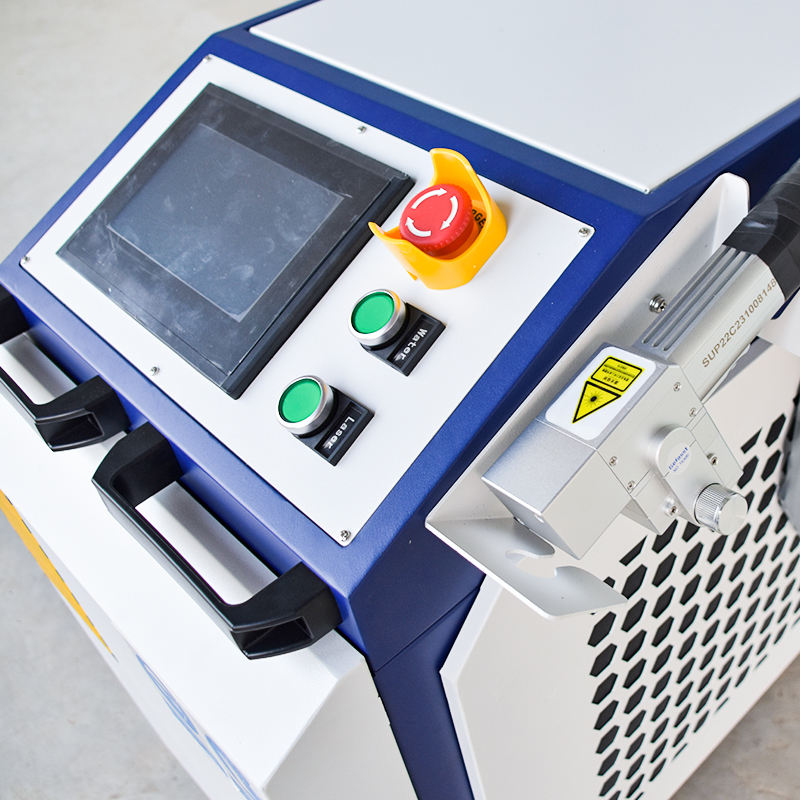
Minimizing Downtime with In-Situ Laser Cleaning Machine Deployment
Real-time cleaning without disassembly or relocation
Laser cleaning equipment lets maintenance crews get rid of rust, oxides, and other buildups right there on machines that are still running, so they don't have to take things apart or move them somewhere else. According to what many industry experts have seen, this on-site method cuts down maintenance time anywhere from about 30% to maybe even half compared with old school techniques because workers can fix problems without stopping the whole production line. What makes these lasers special is how they work without wearing away materials, which means the base material stays intact. Plus, they actually perform pretty well even in tight spots where conventional tools would struggle, cutting down both what people spend on labor and all those annoying interruptions during operations.
Case study: Automotive assembly line uptime improvement (12.7% reduction in scheduled maintenance downtime)
Car makers are seeing real improvements in productivity when they bring laser systems onto their moving production lines for cleaning welds as they go. At one plant, maintenance downtime dropped by about 12.7% over half a year, which translates to roughly 340 extra production hours every year. The main reason? No longer having to take apart conveyor belts just to clean components, something that used to cause stops lasting between 3 to 5 hours each time it happened. With less time needed for surface prep work and cheaper materials being consumed overall, operations saved around 18% on costs according to some research published last year comparing different maintenance approaches across the industry.
Extending Equipment Life Through Precision Rust and Oxide Removal
Laser cleaning significantly prolongs equipment service life by removing corrosive agents—like rust and oxidation—without compromising structural integrity. Its non-abrasive, selective ablation preserves base material properties, preventing premature failure in critical industrial assets such as hydraulic cylinders, turbine blades, and load-bearing infrastructure.
Selective ablation of Fe₂O₃/Fe₃O₄ layers without substrate damage (SEM-verified)
Tuning the laser wavelength precisely allows for selective removal of iron oxide layers like Fe2O3 and Fe3O4 through photothermal ablation techniques. The reason this works so well is simple physics really - oxides tend to soak up laser energy much better than the base metal underneath them, which means contaminants just disappear without leaving behind those pesky heat affected zones we all know and hate. When tested under scanning electron microscopes, there's absolutely no evidence of micro cracks forming or any kind of phase change happening in the substrate material. Wall thickness stays exactly where it should be and mechanical properties remain intact throughout the process. What does this mean practically? No more stress points developing that would otherwise speed up corrosion fatigue issues down the road.
Laser vs. abrasive blasting: Impact on fatigue life of structural steel
When abrasive blasting is used on structural steel surfaces, it actually creates problems like tiny cracks, leaves behind embedded media particles, and generates tensile residual stresses that can cut down on fatigue strength by around 30%. On the flip side, laser cleaning works differently. It keeps the original surface features intact and maintains those helpful compressive stresses since there's no physical contact involved during the process. According to various industry reports, steel treated with lasers tends to handle about two to three times as many stress cycles before breaking compared to what happens with abrasively blasted steel. This means longer service intervals for critical components such as bridge supports and crane booms, plus significantly lower chances of cracks spreading throughout these important load-bearing structures over time.
Key advantages over mechanical methods:
- Zero media embedment, eliminating stress risers
- Retention of compressive surface stresses (+200–300 MPa)
- Prevention of cold working deformation
Fatigue life comparison:
| Method | Surface Roughness (Ra) | Residual Stress | Fatigue Life (cycles) |
|---|---|---|---|
| Abrasive Blasting | 2.5–4.0 µm | Tensile | 500,000 |
| Laser Cleaning | 0.8–1.2 µm | Compressive | 1,200,000+ |
Preserving Critical Tolerances in Mold and Tool Maintenance
Sub-micron contaminant removal while maintaining ±0.5 µm dimensional integrity
Laser cleaning allows for extremely accurate removal of tiny contaminants like oxides and leftover materials without affecting how stable the dimensions remain. The system can target particles smaller than a micrometer while keeping the base material intact within about half a micrometer tolerance. This makes laser cleaning essential for those high precision injection molds and forming tools where even small changes lead to defective parts. Traditional abrasive techniques wear down tool surfaces over time, but lasers keep the original shape because they deliver energy in a controlled way. Take automotive mold maintenance as an example case study we've seen recently. With such precise control, there's no dimensional drift happening which means factories don't have to spend extra money on remachining work. Tools last longer obviously, and some shops report cutting their scrap rates around 30% when switching to laser tech. So beyond just maintaining quality standards, this approach actually helps manufacturers meet their green objectives too.
High-Value Surface Restoration for Aerospace and Automotive Components
Non-destructive thermal barrier coating residue and weld discoloration removal (AMS 2750E compliant)
Laser cleaning offers really precise surface restoration work for those critical parts like aerospace turbine blades and automotive powertrain components. These systems can target and remove thermal barrier coatings and weld discolorations using controlled energy levels around 3 joules per square centimeter. What makes this approach special is how it keeps the underlying metal properties intact while still meeting industry standards such as AMS 2750E requirements. Research shows that over 99 percent of contaminants get removed without affecting the base material's hardness or fatigue characteristics something absolutely necessary for parts needing FAA certification. Compared to traditional chemical stripping methods which might cause issues like hydrogen embrittlement, laser technology gets rid of all those toxic chemicals and maintains tight dimensional control within plus or minus 0.5 micrometers on turbine seal surfaces. When working on electric vehicle battery trays, the non-contact nature of laser cleaning helps avoid short circuits when removing weld spatter, making these parts last about 40% longer than what we see with manual abrasive techniques. And in titanium aerospace forgings where surface quality matters so much for overall part performance, the consistent results from laser processing cut down on scrap rates by roughly 22% across production runs.
Ready to Elevate Your Industrial Maintenance with Reliable Laser Cleaning Solutions?
Industrial maintenance demands efficiency, precision, and durability—all areas where laser cleaning outperforms traditional methods by minimizing downtime, extending equipment life, and preserving critical tolerances. To unlock these benefits for your operations (or your clients, if you’re a reseller), partner with a manufacturer rooted in industrial expertise and global reliability.
Arllaser (Foshan ARL Mechanical & Electrical Equipment Co., Ltd.) is your trusted provider of industrial-grade laser cleaning solutions. With 10 years of manufacturing experience, a 3,600 m² production facility, and CE/FDA/ROHS certifications, our laser cleaning machines are engineered for performance and compliance. Our handheld, mobile, and industrial-grade systems (1500W/2000W/3000W) deliver 40% faster rust/oxide removal, zero consumables, and consistent results—trusted by 300+ aerospace and automotive manufacturers worldwide. We offer tailored solutions for mold maintenance, aerospace component restoration, automotive assembly lines, and structural steel upkeep, backed by 24/7 technical support, global delivery with world-class packaging, and one-stop customization.
Whether you’re looking to reduce maintenance costs, extend equipment lifespan, or meet strict industry standards, Arllaser has the expertise and products to support your goals. Contact us today for a no-obligation consultation, access to ROI analysis reports, and to explore how our laser cleaning solutions can transform your industrial maintenance processes.
Table of Contents
- Minimizing Downtime with In-Situ Laser Cleaning Machine Deployment
- Extending Equipment Life Through Precision Rust and Oxide Removal
- Preserving Critical Tolerances in Mold and Tool Maintenance
- High-Value Surface Restoration for Aerospace and Automotive Components
- Ready to Elevate Your Industrial Maintenance with Reliable Laser Cleaning Solutions?