 EN
EN



Robot Welding Fundamentals: Definition, Core Principles, and Industrial Role
What is robot welding? A precise, application-focused definition aligned with ISO 8553 and AWS D16.1 standards
When we talk about robot welding, we're really referring to the process where metal parts get joined together automatically through those programmable robotic arms. These systems work within strict quality standards like ISO 8553 for managing weld quality and follow specific safety rules outlined in AWS D16.1. What makes these robots so valuable? They can achieve repeatability down to half a millimeter or better, which means every weld looks pretty much identical even when producing thousands of units. Fabricators working on steel structures and car manufacturers have seen their rework expenses drop around 18 percent thanks to this consistency, according to industry reports from AMT back in 2025. Looking at the hardware side, most setups feature heavy duty robotic arms capable of handling at least 20 kilograms, come equipped with welding torches that feed wire automatically, and include those essential fume extraction systems right in the design. Choosing the right equipment depends heavily on what kind of materials are being worked with and how fast production needs to move along.
How robot welding works: From programmed path execution to real-time sensor feedback and adaptive AI correction
The process starts with what's called offline programming, where engineers basically test out how the welds will look in a computer model before actually doing them on real parts. When the robots are running, they rely on cameras and laser systems to spot when things go off track - like when parts don't fit quite right or get warped from heat. These systems then make tiny corrections using smart software behind the scenes. The whole setup keeps the welding arc steady and makes sure the metal gets penetrated just right, which means jobs can be done about three times quicker compared to when humans do all the work manually. For companies making aircraft components, there's another benefit too. The system watches the welding process constantly, catching issues like tiny air pockets in the metal long before anyone even notices them. According to some recent studies, this cuts down waste materials by around 22%. With so many factories looking to save money on staffing costs while keeping their workers safe, automated welding has become pretty much essential for any serious manufacturing operation these days.
Essential Components of a Robot Welding System
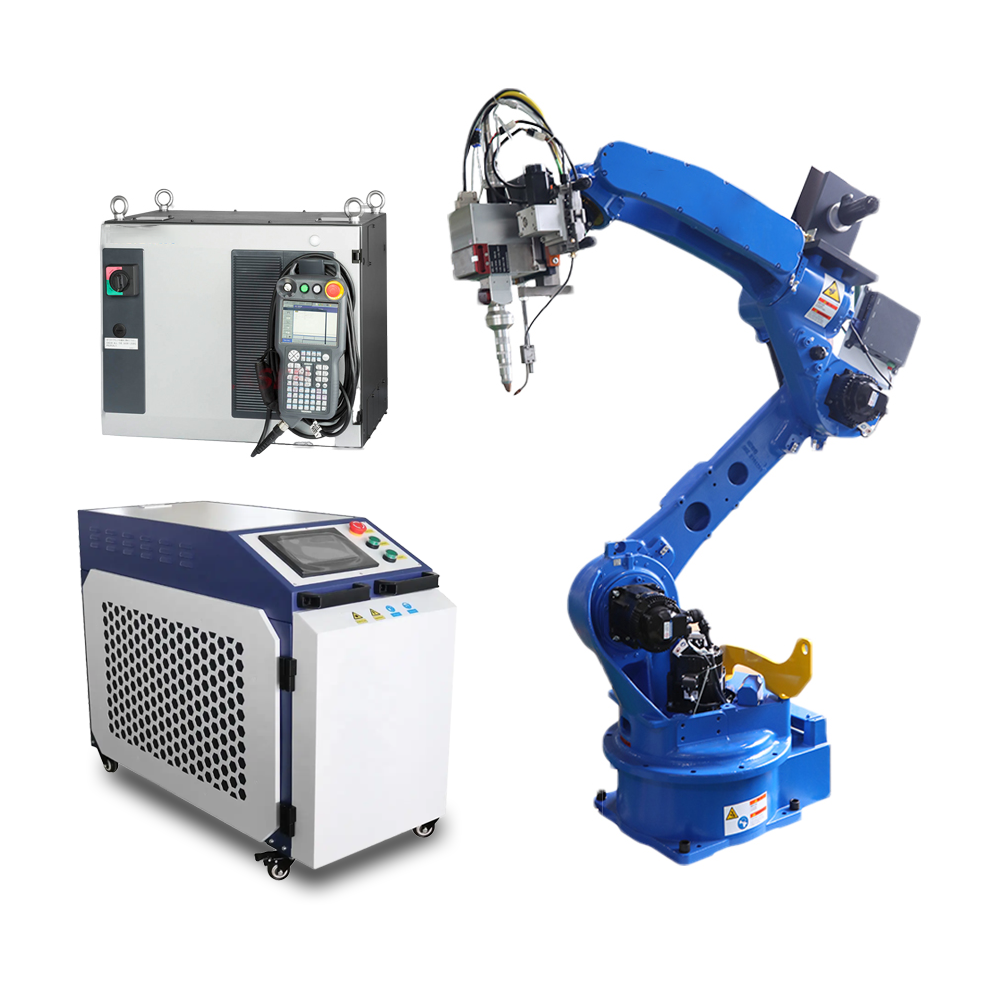
Hardware stack: Robot arm (payload, reach), welding torch, power source, and integrated safety interlocks
The hardware base of a robotic welding system is built around four main parts that work together. The first component is typically a six axis articulated robotic arm. These arms can move with incredible precision, often within half a millimeter for repeatable results. How much weight the arm can handle determines what kinds of parts it can manipulate, and how far it can reach affects the total area where welding operations can take place. Next comes the welding torch attached right at the end of the arm. This device applies heat, feeds in metal filler, and controls protective gases all down to the millimeter level. Third in line is the power supply unit which manages electrical settings like volts and amps to keep the welding arc stable whether using MIG, TIG, or pulse welding techniques. Safety features round out the package including things like light barriers, emergency stops, and sensors that detect when someone gets too close to the work area. When all these pieces come together, they create a system that welds reliably at high speeds while keeping workers away from harmful fumes, dangerous UV light exposure, and flying metal particles.
Software ecosystem: Offline programming (OLP), path optimization, and real-time monitoring dashboards
Software plays a key role in turning what engineers design into actual welding work that can be done consistently every time. With offline programming tools, companies can do complete virtual testing before any real setup happens. These tools simulate everything from where the weld path will go to potential collisions and whether the welding torch can reach all areas, which cuts down on physical setup time maybe around 70%. Then there are path optimization algorithms that fine-tune how the robot moves, making sure it travels shorter distances while keeping good torch angles and avoiding problems when working on complicated joints. During actual production runs, operators watch real-time dashboards showing live data from sensors like voltage changes, wire feed rates, and how well the seam is being tracked. This data gets compared against quality standards defined by ISO 8553. If something goes wrong and measurements fall outside normal ranges, the system either fixes the issue automatically or sends warnings to technicians so they can step in. This helps keep welds consistent, stops defects from slipping through, and makes sure the whole process stays under control based on real data.
Major Robot Welding Processes and Their Best-Fit Applications
MIG, TIG, laser, and resistance spot welding — process physics, weld quality metrics, and sector-specific adoption (automotive, aerospace, heavy fabrication)
Four primary processes dominate industrial robot welding, each selected for material compatibility, joint geometry, and performance requirements:
- MIG (GMAW) uses continuous wire feed and inert shielding gas to deliver high-deposition welds ideal for thick-section structural steel and heavy fabrication—achieving up to 15 kg/hour deposition rates.
- TIG (GTAW) employs a non-consumable tungsten electrode and precise current control to produce spatter-free, low-heat-input welds on thin, high-alloy materials like Inconel and titanium—critical for fatigue-sensitive aerospace components per FAA AC 43.13-1B.
- Resistance Spot Welding applies localized pressure and electrical current to join overlapping sheet metal—dominating automotive body-in-white assembly with >5,000 welds per shift at 0.5-second cycles and 99.8% consistency.
- Laser Welding focuses high-intensity beams for deep-penetration, narrow-bead welds with minimal heat-affected zones (<0.3 mm), making it ideal for battery tab joining, medical device housings, and hermetic seals.
Process selection balances thickness, metallurgy, and quality demands: laser excels below 3 mm; MIG dominates above 10 mm. Automotive relies on spot welding for 85% of body joints, while aerospace increasingly adopts TIG for critical airframe welds requiring verified mechanical integrity.
Robot Welding vs. Manual Welding: Performance, Economics, and Strategic Fit
Quantified advantages: 3× faster cycle times, <0.5 mm positional repeatability, and up to 40% labor cost reduction (per AMT 2025 benchmark data)
When it comes to welding, robots really bring improvements in how fast things get done, the consistency of results, and overall savings on costs. Looking at the latest AMT benchmarks from 2025 shows something interesting. Automated welding setups can complete cycles about three times quicker compared to what humans manage manually. Plus, they maintain position accuracy below 0.5 mm which means there's way less need for fixing mistakes, throwing away bad parts, or wasting materials. The money saved on labor is pretty impressive too. Companies report cutting their expenses by around 40% when they switch because workers don't have to work extra hours as much, need fewer special certifications, and resources just go further overall. What about consumables? Robotic MIG systems actually consume about 60 percent less wire and use five times less shielding gas than traditional methods do. All these advantages stack up particularly well in factories where they're making large quantities of similar products day after day.
| Performance Metric | Manual Welding | Robot Welding |
|---|---|---|
| Average Cycle Time | Baseline | 3× faster |
| Positional Accuracy | Skill-dependent | <0.5 mm |
| Labor Cost Impact | Higher (hourly wages) | Up to 40% reduction |
| Consumable Efficiency | Higher waste | 60% less wire usage |
When manual welding remains optimal: Low-volume, high-mix, or geometrically complex jobs where ROI and flexibility favor human expertise
There are still situations where manual welding makes complete sense when automation just doesn't pay off because of all the money needed upfront plus how inflexible it tends to be. When dealing with small batches or special orders, particularly anything below about 500 pieces, or working on prototypes that keep changing, spending hours programming robots and then maintaining them usually isn't worth what they deliver. Skilled welders shine in tricky spots nobody else can handle well. Think about overhead work, vertical seams going straight up, or tight spaces where robots struggle. These jobs demand instant decisions based on touch and feel something no preset path can match. The same goes for fixing things out in the field, doing single repair jobs, or fabricating parts with lots of variations. Experienced welders adjust their settings mid-job, tweaking amperage levels, controlling how fast they move, and angling torches differently depending on what materials look like or how components fit together. For this kind of work, there's simply no substitute for human skill and experience. It's not just backup when automation fails, it's actually the best approach for certain tasks.
Ready to Transform Your Production with Reliable Robot Welding Solutions?
Robot welding is the backbone of modern manufacturing—delivering speed, precision, and cost savings that manual processes cannot match. To unlock these benefits for your operations, partner with a manufacturer rooted in industrial expertise, innovation, and global reliability.
Arllaser (Foshan ARL Mechanical & Electrical Equipment Co., Ltd.) is your trusted provider of high-performance robot welding systems. With 10 years of manufacturing experience, a 3,600 m² production facility, and CE/FDA/ROHS certifications, our robot laser welding machines are engineered to meet the demands of automotive, aerospace, heavy fabrication, and medical device industries. Our systems deliver 40% faster welding speeds, 87.5% lower power consumption compared to YAG/TIG alternatives, and ±0.05 mm positional repeatability—trusted by 300+ automotive and medical manufacturers worldwide. We offer tailored solutions for MIG, TIG, laser, and resistance spot welding applications, backed by 24/7 technical support, global delivery with world-class packaging, one-stop customization, and comprehensive pre-sales consultation.
Whether you’re scaling high-volume production, improving weld quality, or reducing labor costs, Arllaser has the expertise and products to support your goals. Contact us today for a no-obligation consultation, access to ROI analysis reports, and to explore how our robot welding solutions can elevate your manufacturing processes.
Email: [email protected]
Phone: +86-18144917403
Website: https://www.arllaser.com
Table of Contents
- Robot Welding Fundamentals: Definition, Core Principles, and Industrial Role
- Essential Components of a Robot Welding System
- Major Robot Welding Processes and Their Best-Fit Applications
- Robot Welding vs. Manual Welding: Performance, Economics, and Strategic Fit
- Ready to Transform Your Production with Reliable Robot Welding Solutions?