 EN
EN



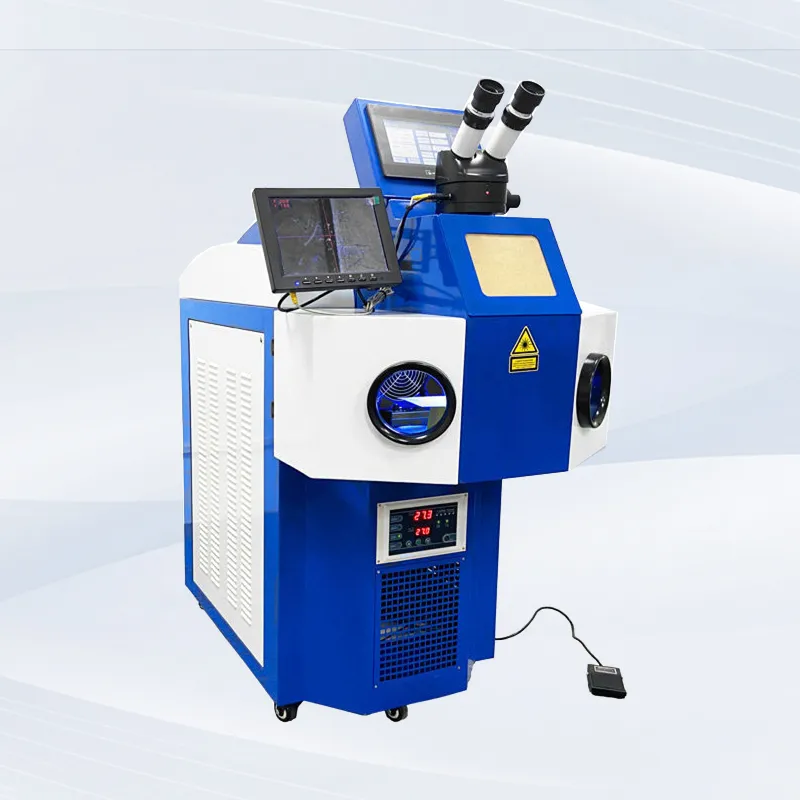
Core Working Principles of Jewelry Welding Machines
Energy Localization and Pulse Control for Micro-Scale Accuracy
Jewelry welding machines achieve microscopic precision through controlled energy localization. Unlike broad-heat methods, these systems deliver intense energy in ultrashort pulses—often under 10 milliseconds—confining thermal impact to a pinpoint area. This pulse control prevents collateral damage to delicate gemstones or thin chains by limiting heat diffusion. Operators adjust pulse duration, frequency, and peak energy to match metal properties: gold typically requires shorter, lower-energy pulses than platinum to avoid melting. Advanced units use real-time sensors to modulate output, maintaining consistent weld depth below 0.5 mm. Such precision enables repairs like reattaching prongs or welding eyeglass hinges without distorting adjacent areas—a feat impossible with traditional torches.
Optics, Power Delivery, and Thermal Management in Compact Systems
Integrated optical systems magnify work areas 10x–30x while laser or fiber-optic delivery directs energy with micron-level accuracy. Mirrored galvanometers steer beams at speeds up to 1,000 mm/s, enabling complex joins in confined spaces. Power units convert standard voltage into stable high-frequency currents (50–200 Hz), ensuring consistent arc performance despite workshop power fluctuations. Crucially, compact liquid-cooling channels dissipate heat within seconds, preventing cumulative thermal buildup during repetitive tasks. This synergy allows continuous operation without warping temperature-sensitive materials like enamel or pearls. Optimized thermal management has been shown to reduce distortion in silver filigree by 78% compared to air-cooled units.
Types of Jewelry Welding Machines: Pulse Arc, Laser, and Microwelders
Pulse Arc Welding: Simplicity, Conductivity, and Ideal Use Cases
Pulse arc welders—also known as micro TIG systems—use pulsed electrical energy between a non-consumable electrode and the workpiece. Key advantages include:
- Low learning curve, making them ideal for entry-level technicians
- Cost-effectiveness, with significantly lower upfront investment than laser alternatives
- Optimal applications: chain repairs, jump ring assembly, and attaching findings
This method is less suited for metals prone to heat-induced embrittlement—such as certain white gold alloys—where excessive thermal input can compromise joint integrity. Its simplicity and reliability make it the preferred choice for workshops focused on routine, high-volume repairs.
Laser Welding: Photon-Driven Fusion with Sub-Millimeter Precision
Laser welding systems generate amplified light beams to fuse metal at the photon level. Technical hallmarks include:
- Ultra-focused energy (0.1–0.5 mm beam diameter), enabling stone-adjacent repairs without thermal transfer
- Minimal heat distortion, preserving the structural integrity of high-karat gold and intricate filigree
- Premium applications: retipping prongs, repairing engravings, and precision cosmetic restoration
Though requiring moderate operator skill, laser welding delivers superior repeatability and tighter process control. Leading manufacturers report up to 60% faster finishing times versus traditional soldering for complex tasks.
Why Jewelry Welding Machines Outperform Traditional Methods
Heat-Affected Zone (HAZ), Structural Integrity, and Surface Finish Comparison
Jewelry welding machines decisively outperform traditional soldering by minimizing the Heat-Affected Zone (HAZ)—the region where thermal stress degrades metallurgical structure. While torch soldering spreads heat broadly (often exceeding 600°C), risking gemstone damage, oxidation, and warping, modern welders confine energy to sub-millimeter points. This preserves crystalline grain structure, retaining over 90% of the base metal’s original tensile strength, unlike soldered joints that rely on brittle filler alloys. Surface quality diverges sharply: laser and pulse arc welds produce near-invisible seams with minimal porosity, requiring only light polishing. In contrast, traditional methods frequently yield oxidized, fire-scaled joints demanding extensive mechanical cleanup to conceal discoloration and flux residue. By eliminating uncontrolled HAZ expansion, jewelry welding ensures lasting structural reliability and premium aesthetics unattainable with legacy techniques.
Selecting the Right Jewelry Welding Machine for Your Workshop
Choosing the optimal jewelry welding machine requires evaluating three critical factors: project complexity, budget constraints, and workspace limitations. For delicate repairs like chain links or micro-soldering, pulse arc welders deliver precise energy control with minimal thermal spread. Laser systems excel in intricate design work requiring sub-millimeter accuracy—but command premium pricing and steeper training curves. Microwelders offer versatile TIG-based functionality across diverse tasks at moderate cost points. Measure your bench space carefully—compact models under 18" width conserve valuable workshop area. Beginners should prioritize intuitive interfaces with preset programs calibrated for common alloys; advanced users may seek customizable pulse modulation and programmable duty cycles. Whenever possible, test units in person—and review technical specifications like amperage range, cooling capacity, and rated duty cycle—to ensure alignment with your production volume and material mix. This methodical approach prevents overinvestment while ensuring seamless integration into your jewelry-making workflow.
FAQ Section
What is the heat-affected zone (HAZ) in jewelry welding?
The Heat-Affected Zone (HAZ) refers to the area surrounding the weld where thermal stress can degrade the metallurgical properties of the base material. Jewelry welding machines minimize HAZ by confining energy to sub-millimeter points, thereby preserving the material's structural integrity.
What advantages do laser welding machines offer?
Laser welding machines provide ultra-focused energy, minimal heat distortion, and superior precision. These features make them ideal for stone-adjacent repairs, intricate designs, and cosmetic restoration, though they require more operator skill compared to other methods.
Which welding machine is best for beginners?
Pulse arc welders are highly recommended for beginners due to their low learning curve and cost-effectiveness. They are ideal for routine repairs like chain links and jump rings.
Are microwelders versatile?
Yes, microwelders offer TIG-based functionality that covers diverse tasks, making them a versatile and moderately priced option for various applications.