 EN
EN



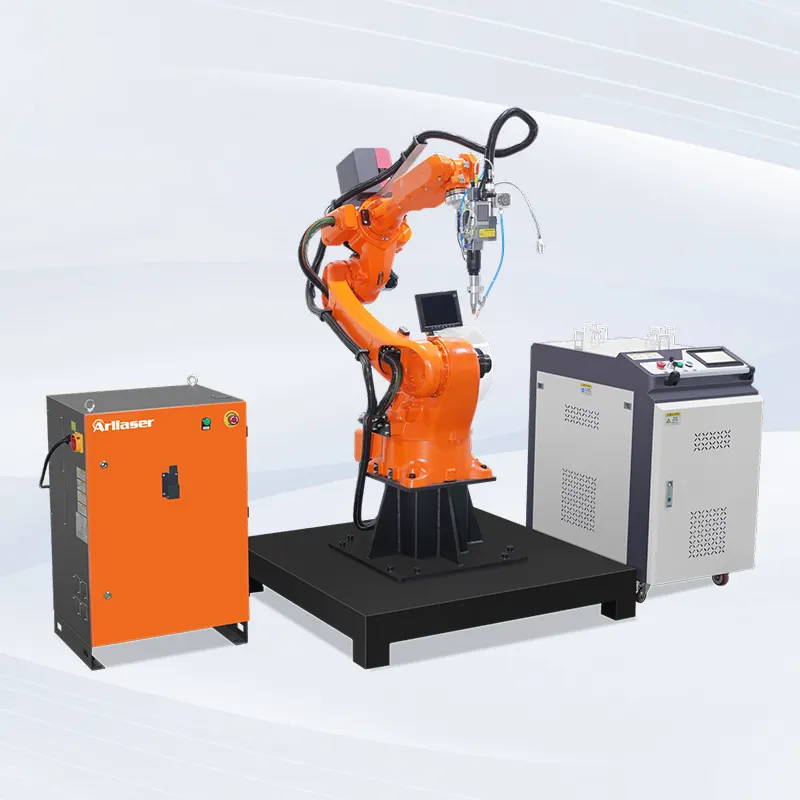
Automotive Industry: High-Volume Precision and the Benchmark for Robot Welding
Why robot welding dominates body-in-white assembly: speed, repeatability, and ISO 6858 compliance
Automakers rely on robot welding for body-in-white assembly because it delivers unmatched speed, repeatability, and structural integrity. A single robotic cell can complete hundreds of spot welds per minute with positional accuracy within ±0.02 mm—far exceeding manual capabilities. This consistency directly supports compliance with ISO 6858 for structural weld integrity, reducing rework rates to under 1%. Robot welding also minimizes operator exposure to sparks, fumes, and heavy lifting, significantly improving workplace safety. Leading manufacturers report cycle-time reductions of 30% or more when transitioning from manual to automated lines—while maintaining uniform heat input and penetration depth across every joint. The convergence of precision, throughput, and safety makes robot welding the undisputed standard for high-volume car body production.
Tesla Giga Berlin case study: integrated structural battery pack welding with collaborative robots
At its Berlin Gigafactory, Tesla integrated collaborative robots to weld its structural battery pack—a pioneering application of cell-to-body integration. These robots perform pulsed laser welding directly on battery cells mounted into the vehicle frame, achieving micron-level accuracy without compromising joint strength. Vision-guided seam tracking compensates for minor part variations in real time, sustaining a yield rate above 99.5%. By replacing manual welding, Tesla reduced cycle time by over 40% and eliminated post-weld grinding entirely. This implementation demonstrates how robot welding enables radical design innovation while meeting stringent quality, safety, and production efficiency requirements.
Aerospace and Medical Devices: Robot Welding for Micro-Precision and Full Traceability
Robot welding has become indispensable in aerospace and medical device manufacturing, where micron-level accuracy and full regulatory traceability are non-negotiable. Advanced robotic systems equipped with high-resolution vision and seam-tracking sensors achieve weld repeatability within ±0.1 mm—even on complex, freeform geometries. In critical applications like titanium component fabrication, precise control of heat input under inert gas shielding prevents oxide formation and preserves biocompatibility—essential for implants and surgical tools. Compared to manual processes, robotic automation reduces defect rates by up to 50% while increasing throughput by 30–35%, making it a strategic enabler for mission-critical production.
Titanium micro-welding under inert gas: meeting <0.1 mm tolerance and biocompatibility requirements
Titanium alloys demand strict inert gas shielding during welding to avoid embrittlement and oxidation. Robot welding systems integrated with real-time gas flow control and closed-loop parameter adjustments consistently maintain the tight tolerances required by aerospace and medical standards. For example, micro-welding thin-wall titanium components—such as pacemaker housings or turbine blades—requires heat-affected zones smaller than 0.1 mm to preserve material integrity and biocompatibility. Robotic precision, adaptive power modulation, and controlled inert atmospheres ensure each weld satisfies both mechanical performance and regulatory cleanliness criteria.
AS9100D/ISO 13485 compliance: real-time seam tracking and auditable weld logs
Meeting AS9100D (aerospace) and ISO 13485 (medical devices) hinges on full process traceability—from raw material to finished part. Modern robot welding cells meet this requirement through integrated seam tracking sensors that monitor joint position and geometry in real time, automatically adjusting torch path and parameters. Each weld is logged with timestamp, current, voltage, wire feed rate, and gas flow data—creating a secure, digital audit trail for compliance verification. This eliminates documentation errors inherent in manual logging and provides instant traceability, reducing non-compliance risk and accelerating certification cycles. As such, robot welding is no longer just a production tool but a foundational element of quality management in regulated industries.
Heavy Industrial Sectors: Robot Welding for Safety, Consistency, and Scalability in Demanding Environments
Reduction in arc-flash incidents and operator exposure on offshore and shipyard fabrication lines
Robot welding enhances safety in high-risk heavy industrial environments—including offshore platforms and shipyards—by removing operators from proximity to arc-flash hazards. Automated systems execute welds in confined, elevated, or hazardous zones without human intervention, drastically lowering incident rates associated with manual welding. This alignment with occupational safety mandates—such as OSHA 1910.252 and EU Directive 2009/104/EC—makes robotic welding a key component of modern risk mitigation strategies in fabrication.
Thick-section welding automation: adaptive control for variable joint geometry in construction steelwork
Adaptive robot welding systems excel in construction steelwork, delivering consistent penetration and bead profile across thick-section materials (25+ mm) despite thermal distortion and joint geometry variation. Real-time seam tracking and dynamic parameter adjustment compensate for part warpage and fit-up inconsistencies—eliminating manual rework on load-bearing structural elements. This ensures infrastructure projects meet stringent weld integrity requirements (e.g., AWS D1.1, EN 1090-2) while compressing project timelines and improving first-pass yield.
Emerging Applications: Strategic ROI-Driven Robot Welding Adoption Beyond Traditional Sectors
Robot welding is expanding beyond traditional manufacturing into sectors where precision, repeatability, and measurable ROI drive adoption. These emerging applications leverage automation not just for scale—but to solve unique technical challenges, improve quality assurance, and accelerate time-to-market.
Agriculture and petrochemicals: modular robot cells enabling certified weld quality for stainless components
Modular robot welding cells are transforming maintenance and fabrication in agriculture and petrochemical operations. Portable, reconfigurable systems deliver certified welds on stainless steel irrigation manifolds, reactor vessels, and pipeline fittings—ensuring corrosion resistance and long-term reliability. Automation guarantees consistent penetration and eliminates porosity defects responsible for field failures. One dairy equipment manufacturer reduced rework by 40% while achieving full ASME BPVC Section IX compliance—demonstrating how modular robotics bring shop-floor quality standards to remote or mobile work sites.
Jewellery and prototyping: high-precision pulsed laser robot welding for delicate alloys
Pulsed laser robot welding empowers jewellery artisans and rapid prototyping firms to join delicate gold, platinum, and cobalt-chrome alloys with 0.05 mm precision—preserving intricate filigree, gem settings, and micro-features without thermal distortion. The resulting welds meet X-ray quality standards for medical-grade prototypes and high-value finished pieces. A custom jewellery studio increased throughput by 30% while eliminating soldering inconsistencies; similarly, prototyping labs use the same technology to fabricate functional medical device prototypes requiring biocompatible, repeatable micro-joins—proving that robot welding’s value extends far beyond mass production.
FAQs
Why is robot welding preferred in high-volume automotive production?
Robot welding offers unmatched speed, precision, repeatability, and structural integrity, making it ideal for high-volume automotive applications. It ensures compliance with structural welding standards like ISO 6858 while improving safety and reducing cycle times.
What makes robot welding essential in aerospace and medical device manufacturing?
In aerospace and medical industries, strict regulations demand micron-level precision and full traceability. Robot welding ensures high repeatability and compliance with standards like AS9100D and ISO 13485 while reducing defects and enhancing throughput.
How does robot welding improve safety in heavy industries?
Robot welding minimizes human exposure to hazardous conditions such as arc-flashes and confined spaces in demanding environments, aligning with safety standards like OSHA 1910.252 and EU Directive 2009/104/EC.
Can modular robot welding cells be used in remote or mobile applications?
Yes, modular robot welding cells are designed for portability and reconfiguration, enabling certified weld quality for remote or mobile applications in agriculture, petrochemicals, and other industries.
How does robot welding apply to specialized fields like jewelry and prototyping?
High-precision pulsed laser robot welding is used in jewelry and prototyping to join delicate alloys like gold and platinum with extreme accuracy, preserving intricate details and ensuring repeatable, high-quality results.
Table of Contents
- Automotive Industry: High-Volume Precision and the Benchmark for Robot Welding
- Aerospace and Medical Devices: Robot Welding for Micro-Precision and Full Traceability
- Heavy Industrial Sectors: Robot Welding for Safety, Consistency, and Scalability in Demanding Environments
- Emerging Applications: Strategic ROI-Driven Robot Welding Adoption Beyond Traditional Sectors
-
FAQs
- Why is robot welding preferred in high-volume automotive production?
- What makes robot welding essential in aerospace and medical device manufacturing?
- How does robot welding improve safety in heavy industries?
- Can modular robot welding cells be used in remote or mobile applications?
- How does robot welding apply to specialized fields like jewelry and prototyping?