 EN
EN


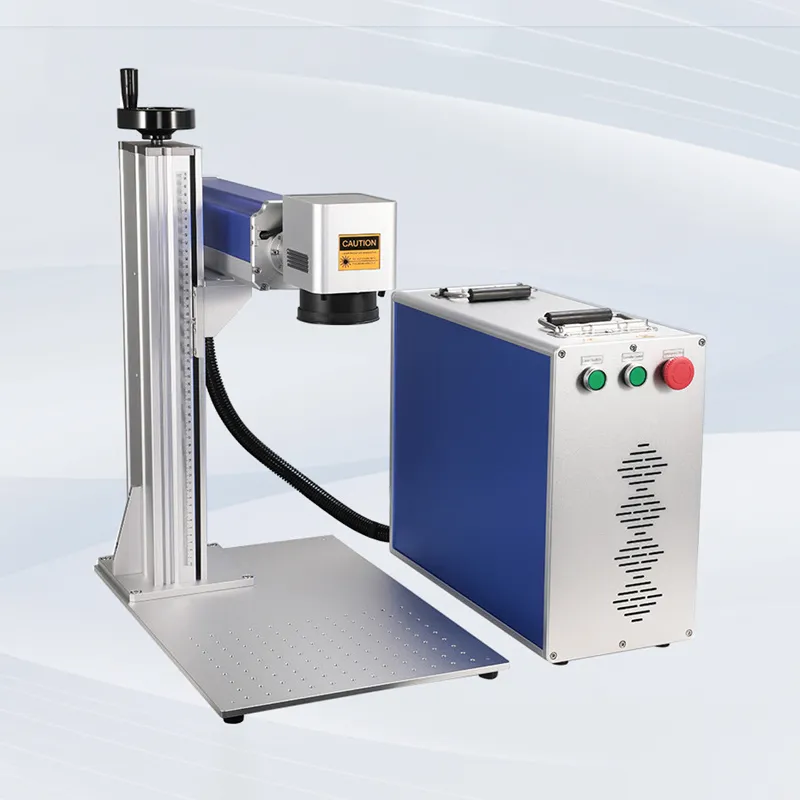
Fiber Laser Marking Machines: Top Choice for Industrial Metal Marking
Why Fiber Lasers Dominate Stainless Steel, Aluminum, and Titanium Marking in 2026
Fiber laser marking machines have become the industrial standard for metal marking because their 1064 nm wavelength is efficiently absorbed by stainless steel, aluminum, titanium, and most other metals. This direct absorption enables high-contrast, permanent marks—such as serial numbers, barcodes, and logos—without inks, coatings, or chemical etchants. With marking speeds up to 6,000 mm/s and a theoretical lifespan of 50,000 hours, fiber lasers deliver exceptional uptime and low maintenance costs. Their non-contact process avoids mechanical stress or surface deformation, even on curved or highly reflective parts. By 2026, advances in beam quality and pulse control—especially with MOPA architectures—have further improved contrast and color consistency on anodized aluminum and titanium alloys, reinforcing their dominance across automotive, aerospace, and electronics manufacturing.
Key Parameter Tuning: Power, Frequency, and Scan Speed for Permanent Metal Marks
Achieving durable, legible marks on metals requires precise tuning of three core parameters: power, frequency, and scan speed. Power (typically 20–50 W) governs engraving depth—higher settings yield deeper, more abrasion-resistant marks on stainless steel or titanium. Frequency (20–80 kHz) regulates heat input: lower frequencies favor dark annealed marks on stainless steel, while higher frequencies reduce thermal risk on thin aluminum or heat-sensitive alloys. Scan speed (1,000–6,000 mm/s) balances contrast and throughput—slower speeds deepen color but extend cycle time. For example, a 30 W MOPA fiber laser operating at 60 kHz and 2,000 mm/s produces a stable black mark on 304 stainless steel with ~10 µm depth and excellent readability after exposure to harsh environments. Crucially, MOPA systems add pulse-width flexibility, enabling reliable color marking on stainless steel and titanium without sacrificing permanence—meeting traceability requirements set by ISO/IEC 15415 and AS9132 for aerospace components.
CO₂ and UV Laser Marking Machines: Precision Solutions for Plastics
CO₂ Lasers for High-Speed, Cost-Effective Marking on ABS, Polycarbonate, and Acrylic
CO₂ laser marking machines operate at a 10,600 nm wavelength, making them highly effective for organic materials—including ABS, polycarbonate, acrylic, wood, and coated metals. They create durable, high-contrast marks through controlled thermal interaction: either surface vaporization or carbonization-induced color change. This process supports fast, economical marking for packaging, automotive interiors, and consumer electronics housings. As a non-contact method, CO₂ marking preserves part integrity and dimensional stability—critical when marking large-format or thin-walled plastic components. According to the International Organization for Standardization (ISO 13485), CO₂ systems are widely validated for use in medical device labeling where material compatibility and repeatability are essential.
UV Laser Marking Machines for Cold Ablation on Sensitive or Medical-Grade Plastics
UV laser marking machines—emitting at 355 nm—rely on photochemical cold ablation rather than thermal energy, making them uniquely suited for sensitive substrates like polypropylene (PP), PET films, silicone, and implant-grade polymers. The minimal heat-affected zone prevents warping, yellowing, or micro-cracking, while the tightly focused beam achieves line widths as fine as 0.01 mm. This precision supports regulatory compliance for pharmaceutical serialization (per FDA 21 CFR Part 11), flexible printed electronics, and sterile medical devices—where any thermal compromise could affect biocompatibility or functional performance. Though initial investment is higher than CO₂ or fiber alternatives, UV lasers offer unmatched reliability for mission-critical applications governed by ISO 13485 and IEC 60601-1.
Advanced Laser Marking Machines: Green and Femtosecond Options for Hybrid & High-Fidelity Applications
For applications that demand extreme precision or involve challenging substrates, standard fiber or CO₂ systems may fall short. Advanced laser marking configurations—green (532 nm) and femtosecond lasers—address these gaps with specialized beam characteristics that minimize thermal damage and broaden material compatibility. Increasingly, manufacturers integrate these technologies into hybrid platforms, enabling seamless switching between high-speed production and ultra-fine feature marking within a single workcell.
Green (532 nm) Laser Marking Machines for Highly Reflective Metals and Colored Plastics
Green lasers overcome the high reflectivity that limits infrared systems on copper, brass, gold, and certain coated or anodized surfaces. Their shorter 532 nm wavelength enhances absorption in both reflective metals and pigmented plastics—producing crisp, high-contrast marks without substrate melting or charring. This makes green lasers ideal for electronics enclosures, jewelry, and medical instrument housings where aesthetic finish and functional traceability must coexist. The beam’s small focal spot supports micron-level detail on complex geometries, satisfying traceability standards such as UDI (Unique Device Identification) for Class II and III medical devices.
Femtosecond Laser Marking Machines for Sub-Micron Precision Without Thermal Stress
Femtosecond lasers generate ultrashort pulses (≤1,000 fs) that remove material via direct ablation—bypassing thermal diffusion entirely. The result is virtually zero heat-affected zone, no micro-cracking, and sub-micron positional accuracy. These attributes are indispensable for marking brittle ceramics, semiconductor wafers, glass-based sensors, and titanium medical implants—where even minor thermal stress could degrade structural integrity or biocompatibility. Internal glass marking, selective layer removal in multilayer PCBs, and micro-feature serialization on MEMS devices are now routinely achieved using femtosecond technology. As micromachining demand grows—projected to exceed USD 6 billion globally by 2033 (Grand View Research)—femtosecond lasers are becoming central to next-generation manufacturing compliance, particularly under ISO 10993 and ASTM F2129 for implantable device traceability.
How to Choose the Right Laser Marking Machine in 2026: Material, Throughput, and Compliance Guide
Selecting the right laser marking machine in 2026 requires aligning technology with material behavior, production volume, and regulatory obligations. Start with your primary substrate:
- Metals (stainless steel, aluminum, titanium) → Prioritize fiber lasers for speed, durability, and cost-per-part efficiency. MOPA variants add color and contrast control for demanding applications.
- Plastics (ABS, polycarbonate, acrylic) → CO₂ lasers offer optimal balance of throughput, affordability, and proven reliability.
- Medical-grade or heat-sensitive plastics (PP, silicone, PET) → UV lasers ensure cold ablation, meeting FDA and ISO 13485 validation requirements.
- Highly reflective metals (copper, brass, gold) or colored polymers → Green lasers provide superior absorption and aesthetic fidelity.
- Ultra-high-precision or thermally fragile parts (implants, semiconductors, glass optics) → Femtosecond lasers deliver sub-micron accuracy with zero thermal compromise.
Next, evaluate throughput needs: high-volume lines benefit from higher-power fiber (30–50 W) or CO₂ systems with galvo scanning optimized for <2-second cycle times. Finally, verify compliance—not just with general safety standards (IEC 60825-1), but also industry-specific traceability mandates: AS9132 for aerospace, UDI for medical devices, and GS1 standards for supply chain barcodes. A disciplined selection process grounded in material science and regulatory foresight ensures long-term operational resilience and return on investment.
FAQ
What types of materials are best suited for fiber laser marking machines?
Fiber laser marking machines work best on metals like stainless steel, aluminum, and titanium. Their efficient absorption of the 1064 nm wavelength makes them ideal for achieving permanent, high-contrast marks without surface damage.
How do I choose between CO₂ and UV laser marking machines?
CO₂ lasers are suitable for marking plastics like ABS, polycarbonate, and acrylic with cost-effective and high-speed processing. UV lasers are designed for sensitive and medical-grade plastics, ensuring precision and regulatory compliance through cold ablation.
What is the advantage of MOPA fiber lasers?
MOPA fiber lasers offer pulse-width flexibility, enabling high-contrast and color-marking capabilities, especially for stainless steel and titanium. These lasers excel in aerospace and electronics applications requiring traceability and aesthetic quality.
Are green lasers suitable for reflective metals?
Yes, green lasers provide superior results on highly reflective metals like copper, brass, and gold, as well as colored plastics. Their 532 nm wavelength ensures crisp, high-contrast marks without substrate damage.
What are femtosecond lasers used for?
Femtosecond lasers deliver sub-micron precision without thermal stress, making them ideal for brittle materials such as ceramics, semiconductor wafers, and titanium implants. They excel in applications requiring extreme accuracy and biocompatibility.
Table of Contents
- Fiber Laser Marking Machines: Top Choice for Industrial Metal Marking
- CO₂ and UV Laser Marking Machines: Precision Solutions for Plastics
- Advanced Laser Marking Machines: Green and Femtosecond Options for Hybrid & High-Fidelity Applications
- How to Choose the Right Laser Marking Machine in 2026: Material, Throughput, and Compliance Guide
- FAQ