 EN
EN



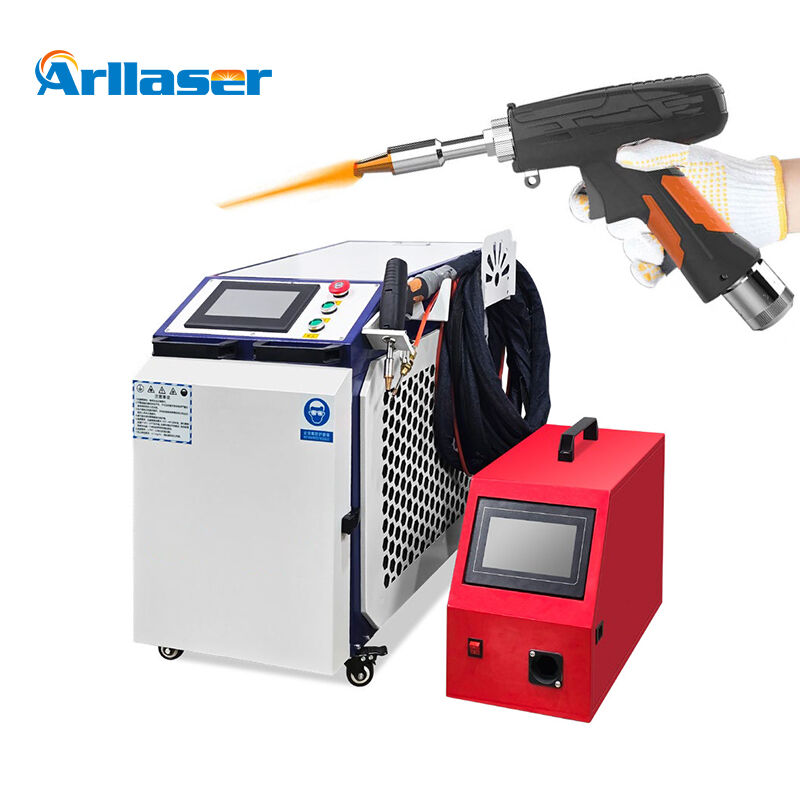
Understanding Handheld Laser Welders: Advantages Over Traditional Welding Methods
The Rise of Handheld Laser Welding Machines in Industrial Applications
According to the latest Fabrication Trends Report from 2024, handheld laser welders are becoming pretty popular these days, making up around 38% of all equipment upgrades across manufacturing facilities. These devices cut down setup time dramatically compared to old school arc welding methods sometimes as much as 90%. What's really impressive is how lightweight they are just 12 pounds total when most traditional welding machines weigh closer to 800 pounds. And despite their small size, they put out a steady 1.5 kW laser beam. Manufacturers love this because it helps save money on filler materials and slashes energy usage somewhere between 40% and 60% for each weld joint. That makes sense why so many shops in auto repair and aerospace parts manufacturing have started switching over to these compact solutions.
Key Differences Between Handheld Laser Welders and Traditional Methods Like MIG and TIG
Handheld laser systems achieve weld speeds of 4–8 mm/s—five times faster than MIG's 0.8–1.6 mm/s—with heat-affected zones (HAZ) as narrow as 0.1–0.3 mm. This precision prevents warping in thin sub-2mm sheet metal, a common issue with TIG welding. The table below highlights key differences:
| Parameter | Laser Welder | MIG/TIG |
|---|---|---|
| Operator skill required | 8 hours training | 80+ hours training |
| Post-weld cleanup | None | Slag/Spatter removal |
| Weld penetration | 0.1–6mm adjustable | Fixed by amperage |
The reduced need for skilled labor and post-processing makes handheld laser welding particularly effective for high-mix, low-volume environments.
Weld Quality, Precision, and Consistency: What Sets Handheld Laser Systems Apart
Handheld laser welders equipped with real-time seam tracking can achieve around 0.02mm positioning accuracy, which is roughly 15 times better than what's possible with manual TIG welding techniques. According to research published by ASM International in 2023 after testing over 10,000 weld samples, these laser systems cut down on porosity issues by about 72 percent and reduce undercutting problems by nearly two-thirds when working with aluminum alloys. Medical device companies are particularly interested in these improvements since they result in approximately 99.98% first-pass success rates for their products. That's way above the standard range of 89 to 93% usually seen with traditional welding approaches.
Matching Handheld Laser Welder Capabilities to Material and Thickness Requirements
Common Materials Processed Using Handheld Laser Welding Machines
These systems effectively join carbon steel, stainless steel, aluminum, and copper—even handling reflective or dissimilar metals that challenge MIG and TIG processes. Typical thickness limits are:
- Carbon/stainless steel: Up to 4 mm
- Aluminum: Up to 4 mm
- Copper: Up to 2 mm
Advanced models handle sheets as thin as 0.5 mm, making them suitable for aerospace components and electronics enclosures where minimal heat distortion is critical.
Selecting Laser Power Based on Material Type and Thickness
Laser power directly influences penetration depth and speed. Optimal settings include:
| Material | 1.5 mm thickness | 3 mm thickness |
|---|---|---|
| Stainless steel | 1,000W | 1,500W |
| Aluminum | 1,200W | 1,500W |
While higher-powered units (1,500W–2,000W) improve throughput for structural applications, they also increase operational costs. Systems with adjustable pulse frequency and beam diameter offer greater flexibility for mixed-material production lines.
Best Practices and Limitations When Welding Thin vs. Thick Metal Sections
Thin sections (0.5–2 mm):
- Use pulsed laser modes to prevent burn-through
- Maintain joint gaps of 0.1–0.3 mm for optimal energy absorption
Thick sections (3–4 mm):
- Pre-heat materials to reduce thermal stress
- Employ multi-pass techniques for deeper penetration
Handheld laser welders face limitations on materials exceeding 4 mm thickness due to insufficient beam penetration. In such cases, hybrid laser-arc systems or traditional methods remain more cost-effective.
Evaluating Core Technical Specifications: Power, Cooling, and Welding Modes
Selecting a handheld laser welder requires careful analysis of three critical technical factors: power output, cooling efficiency, and welding modes. These specifications directly determine operational flexibility, production costs, and weld quality across different industrial applications.
Determining Optimal Laser Power Output for Your Production Needs
Laser power (measured in watts) governs material compatibility and processing speed:
| Power Range | Material Thickness | Common Applications |
|---|---|---|
| 1,000W | Up to 3mm | Decorative metalwork, thin stainless steel sheets |
| 1,500–2,000W | 3–8mm | Automotive panels, mid-thickness structural components |
| 3,000W+ | 8–12mm | Heavy machinery repair, thick alloy fabrication |
Higher wattage enables deeper penetration but increases energy consumption by 20–35%. Most general fabrication shops achieve optimal ROI with 1,500–2,000W systems, which balance performance and cost without over-specification.
Importance of an Efficient Cooling System for Continuous Operation
Effective cooling prevents thermal overload during extended use. Air-cooled units offer portability for fieldwork, while water-cooled systems maintain stable temperatures in high-duty-cycle environments. Facilities operating 8-hour shifts report 45% less downtime using liquid-cooled solutions compared to passive alternatives.
Pulse, Continuous, and Hybrid Welding Modes: Functionality and Application Fit
- Pulse mode: Delivers controlled energy bursts ideal for heat-sensitive materials like copper or thin aluminum
- Continuous mode: Maintains steady beam output for long seam welds in structural steel
- Hybrid mode: Alternates between pulsed and continuous phases to minimize spatter in overlap joints
Choosing the right mode enhances weld integrity and reduces rework across diverse applications.
Avoiding Over-Specification: Balancing Power with Operational Flexibility
The 3,000W systems do have deeper penetration abilities, but most shops actually get along just fine with 1,500 to 2,000W machines for regular workdays. Around seven out of ten fabrication businesses report these mid-range models handle everything they need without breaking a sweat. Going too big on power comes at a real cost though. Shops with overpowered equipment typically spend around $8,000 extra each year on electricity alone, plus deal with more frequent maintenance headaches while the machine sits idle most of the time. When selecting laser wattage, focus on what works best for the materials welders tackle day after day rather than chasing those maximum specs listed in brochures. Practical experience shows this approach saves money and keeps operations running smoothly without unnecessary complications.
Improving Production Efficiency and Measuring Real-World ROI
Throughput and Cycle Time Improvements Compared to Conventional Welding
Handheld laser welders reduce cycle times by 50–70% compared to MIG/TIG methods. Their non-contact process and localized heat input eliminate post-weld grinding, enabling uninterrupted operation at 25% faster traverse speeds. According to a 2025 industry analysis, manufacturers using these systems achieve 8–12 additional weld cycles per hour while maintaining 0.2 mm positional accuracy.
Case Study: Automotive Component Manufacturer Increases Output by 40%
A North American auto parts supplier replaced robotic MIG stations with handheld laser welders for suspension component production. By removing fixturing needs and reducing operator dependency, the company achieved:
- 40% higher daily output (from 320 to 450 units)
- 92% reduction in rework rates through precise energy control
- $2.1M annual savings in labor and consumables
The equipment investment was fully depreciated within 18 months.
Calculating ROI, Payback Period, and Total Cost of Ownership
A realistic ROI model includes:
- Direct savings: Lower gas and electrode costs ($8k–$15k/year) and reduced energy use (3.2 kW vs. 8.5 kW for TIG)
- Labor efficiency: 35–50% faster training curves compared to arc welding
- Quality gains: First-pass yield rates of 99.6%, versus 87–92% with conventional methods
Most industrial users report payback periods under 24 months when upgrading from legacy systems.
Minimizing Investment Risk Through Sample Testing and Trial Use
Manufacturers reduce adoption risk by:
- Requesting material-specific weld samples tested to ISO 15614 standards
- Conducting 30–90 day equipment trials to verify throughput claims
- Negotiating performance-based lease agreements that include maintenance
Phased rollouts lower capital exposure by 60% compared to full-scale deployments.
Ensuring Operator Safety, Ergonomics, and Long-Term Support
Torch Weight, Usability, and Managing Operator Fatigue During Long Shifts
Units under 4.5 lbs reduce muscle strain during 8-hour shifts. Ergonomic torch designs with anti-slip grips and balanced weight distribution enhance control when welding complex joints. Many modern systems incorporate vibration-dampening features to help prevent repetitive stress injuries.
Safety Requirements: PPE, Enclosures, Interlocks, and Compliance
For anyone working around lasers, it's absolutely necessary to have those ANSI Z87.1 rated safety goggles on at all times. These protect eyes from the harmful reflections we get from the 1,060 nm wavelength radiation. The work areas themselves need to be enclosed properly too. They should meet ISO 11553 standards with those automatic interlock systems that will stop the laser operation whenever someone opens the enclosure. And let's not forget about ventilation when dealing with materials like aluminum or copper during welding processes. Without proper OSHA approved fume extraction equipment running constantly, workers could easily exceed safe exposure levels for airborne particles. Managing these particulates isn't just about following regulations but keeping everyone healthy while they're doing their jobs.
Intuitive Control Interfaces: Reducing Training Time and Human Error
Modern handheld laser welders come with preset profiles for common materials like stainless steel (0.5–6 mm) and feature touchscreens with visual error alerts. Simplified menus cut training time by 30% compared to traditional TIG systems, allowing new operators to reach proficiency quickly.
Choosing Reliable Brands With Strong After-Sales Support and Warranty Terms
Prioritize suppliers offering 24/7 technical support and on-site service within 48 hours. Look for warranties covering laser diodes for at least 20,000 hours and motion components for five years. Validate service network reliability using third-party platforms like VerifyMySupplier before finalizing purchases.
Frequently Asked Questions (FAQ)
What are handheld laser welders?
Handheld laser welders are compact welding devices that emit a laser beam to join materials. They are preferred over traditional welding methods due to their efficiency, precision, and portability.
Are handheld laser welders safe to use?
Yes, provided that proper safety measures are in place. It is essential for operators to wear ANSI Z87.1 rated safety goggles, ensure that work areas are properly enclosed, and adhere to ventilation standards during operations.
How do handheld laser welders compare to traditional welding methods?
Handheld laser welders are faster, more precise, and require less operator skill compared to traditional methods like MIG and TIG welding. They also minimize post-weld cleanup and the heat-affected zone.
What materials can handheld laser welders process?
These machines are capable of welding common materials such as carbon steel, stainless steel, aluminum, and copper. They can also handle reflective or dissimilar metals that conventional methods find challenging.
Is the investment in handheld laser welders worthwhile?
Many manufacturers have reported significant ROI, payback periods under 24 months, and substantial savings in labor and consumables by incorporating handheld laser welders into their production lines.
Table of Contents
- Understanding Handheld Laser Welders: Advantages Over Traditional Welding Methods
- Matching Handheld Laser Welder Capabilities to Material and Thickness Requirements
- Evaluating Core Technical Specifications: Power, Cooling, and Welding Modes
- Improving Production Efficiency and Measuring Real-World ROI
- Ensuring Operator Safety, Ergonomics, and Long-Term Support
- Frequently Asked Questions (FAQ)