 EN
EN



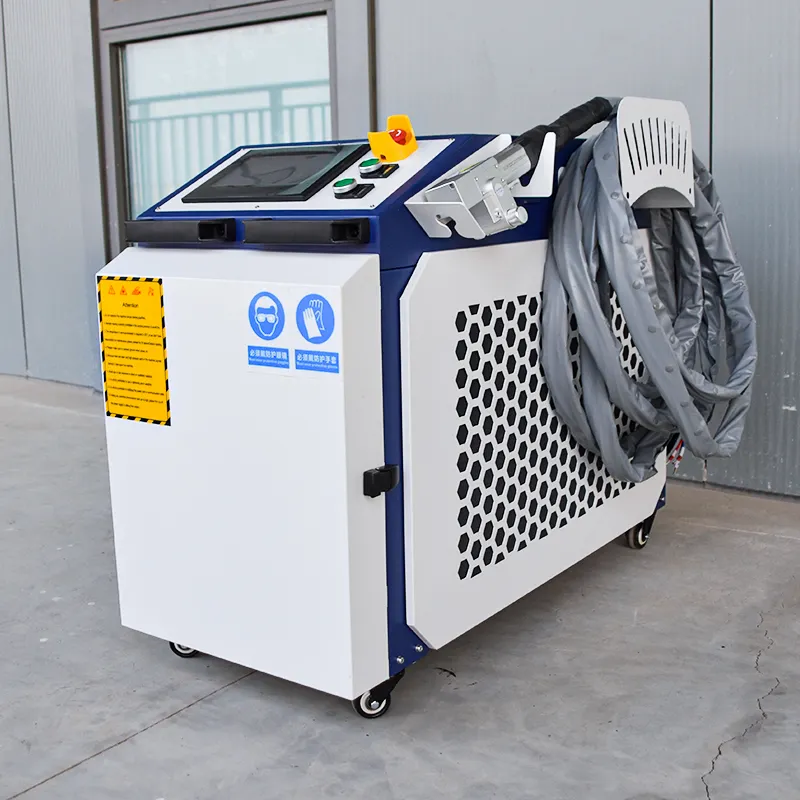
How a Laser Cleaning Machine Works: Core Physics and Process Mechanics
Photothermal ablation demystified: Why light removes contaminants without touching the surface
Laser cleaning works mainly through something called photothermal ablation, which is basically a fancy way of saying the laser heats stuff up until it disappears. The process doesn't touch surfaces directly but instead uses short bursts of laser energy to remove dirt, grime, or other unwanted materials from surfaces. Contaminants tend to soak up certain laser wavelengths better than whatever material they're sitting on top of. Take rust for instance it eats up around 1064 nm light whereas steel just bounces most of that same wavelength right back out. This creates intense heat that makes the contaminant either turn into gas or just pop off the surface entirely, all without any physical contact or rubbing involved. What's really important here is that the actual surface being cleaned stays intact because it needs much stronger laser power to get damaged compared to what's needed to clean away the mess. This difference in how things react to laser energy lets technicians clean very sensitive parts used in airplanes or even old museum pieces where regular scrubbing would cause permanent harm.
Key operational parameters: Pulse duration, fluence, and material-specific absorption thresholds
Three interdependent parameters govern laser cleaning efficacy:
- Pulse duration (nanosecond to femtosecond ranges) controls heat penetration depth—shorter pulses minimize thermal diffusion, protecting sensitive substrates
- Fluence (J/cm²) must exceed the contaminant’s vaporization threshold but remain below the substrate’s damage threshold
- Wavelength determines absorption efficiency; oxides, for instance, absorb 30–50% more 1 µm laser energy than bare metals
| Parameter | Function | Optimization Goal |
|---|---|---|
| Pulse duration | Limits heat diffusion | Match to contaminant thickness |
| Fluence | Drives vaporization | Stay above contaminant threshold but below substrate damage |
| Wavelength | Determines absorption rate | Align with contaminant’s peak absorption band |
Material-specific calibration prevents substrate etching—a critical consideration when processing alloys like aluminum (low melting point) versus titanium (high thermal resistance). Proper tuning achieves up to 99.5% contaminant removal while delivering $740/kWh in operational savings over abrasive alternatives (Ponemon Institute, 2023).
Laser Cleaning Machine Components and Configuration Options
Critical hardware stack: Fiber laser source, galvo scanning head, beam delivery optics, and safety interlocks
Every industrial-grade laser cleaning machine integrates four core components:
- A fiber laser source, typically emitting at 1064 nm, delivers high-power, stable beams via optical fiber—enabling efficient energy transfer and compact system design
- A galvo scanning head, equipped with high-speed, precision mirrors, directs the beam across surfaces at speeds exceeding 10 m/s
- Beam delivery optics, including focusing lenses and protective windows, shape spot size and intensity distribution to match application requirements
- Safety interlocks, compliant with ISO 11553-1:2020, automatically disable the laser upon enclosure breach or sensor anomaly—ensuring operator protection without compromising workflow
This integrated architecture enables consistent, repeatable, non-contact cleaning while meeting global laser safety standards.
Pulsed vs. continuous wave (CW) lasers: Matching laser cleaning machine type to application demands
Choosing between pulsed and continuous wave (CW) laser systems really depends on three main factors: what kind of contamination we're dealing with, how sensitive the material surface is, and just how fast we need things done. Pulsed lasers work by sending out these incredibly short bursts of energy, ranging from nanoseconds all the way down to femtoseconds. These pulses can reach peak power levels exceeding 1 gigawatt per square centimeter, which makes them perfect for removing tiny amounts of oxide buildup on things like turbine blades or battery contacts where precision matters most. On the other hand, continuous wave lasers maintain a constant power level somewhere between 100 and 2000 watts. They shine when it comes to stripping away those thick layers of paint that might be over 500 micrometers deep from big surfaces such as ship hulls or heavy structural steel components.
| Parameter | Pulsed Laser Advantage | CW Laser Advantage |
|---|---|---|
| Thermal penetration | Minimal HAZ (heat-affected zone) | Faster large-area coverage |
| Contaminant type | Micron-scale rust/oxides | Thick coatings |
| Energy efficiency | Lower average power consumption | Higher material throughput |
| Precision | Sub-millimeter feature cleaning | Uniform broad-surface stripping |
For cultural artifact conservation, pulsed systems preserve patinas and fine engravings. Industrial-scale rust removal favors CW configurations—provided absorption coefficients are verified first, as they vary widely (30–80% across common metals) and directly impact safety and performance.
Laser Cleaning Machine Applications by Material and Industry
Metal surface restoration: Rust, oxide, and paint removal on steel, aluminum, and stainless alloys
Laser cleaning equipment gets rid of rust, oxides, and paint from metal surfaces through a process called photothermal ablation. What makes this method special is that it doesn't need any abrasive materials, harsh chemicals, or physical contact with the surface. Different metals react differently when exposed to laser light. For instance, steel and stainless alloys generally work well because we know how they absorb energy. Rust tends to soak up a lot of the 1064 nm wavelength, whereas bare aluminum actually bounces most of that energy back. This means technicians have to carefully adjust the amount of energy delivered so they don't accidentally melt the metal underneath. When operators get the settings right for things like pulse length and how often the laser fires, they end up with surfaces that maintain their original shape, create stronger welds (some tests show tensile strength can jump by around 25%), and allow coatings to stick better. Proper surface prep really pays off too. Metals cleaned properly using lasers last longer in service. Studies indicate these surfaces resist corrosion about 30% better than ones treated with traditional grit blasting methods.
High-value use cases: Aerospace tooling, EV battery weld prep, and cultural heritage conservation
Laser cleaning technology tackles those really important problems where getting the surface right matters a lot. For aerospace companies, this means fixing up turbine blades by taking off thermal barrier coatings with incredible precision - around plus or minus 2 micrometers accuracy while keeping the shape of the airfoils intact. When it comes to making electric vehicles, laser cleaning helps prepare battery terminals by getting rid of those pesky conductive oxides. This actually cuts down on failures at high voltage weld joints by somewhere around half. Art restorers have also found great use for lasers set to very low power levels. They can gently clean away old dirt from bronze statues and stone monuments without damaging the original color finish, carvings, or tiny surface details that just cant be saved using traditional scrubbing or chemical treatments. Looking at all these different uses shows why this specific type of laser technology works so well in areas where safety is paramount, in cutting edge manufacturing processes, and when preserving something truly valuable from history.
Why Choose a Laser Cleaning Machine? Advantages, Limitations, and Realistic Expectations for Beginners
Laser cleaning tech brings some real benefits when it comes to getting surfaces just right for specific jobs but folks need to think realistically about whether these machines fit their particular situation. What makes them stand out? Well, they work without touching the material itself, so important parts like those used in aircraft tools or electric vehicle batteries stay intact during cleaning. Plus there's no chemical mess involved which cuts down on environmental paperwork by around two thirds compared to old solvent methods according to Surface Engineering Journal from last year. Still worth noting though that buying one isn't cheap either ranging anywhere from twenty thousand dollars up into the hundreds of thousands depending on what features are needed. And let's face it, these lasers don't perform equally well across all materials. They shine brightest when dealing with rust spots on steel or removing oxides from aluminum surfaces. But watch out for tricky cases too - things get complicated fast with porous materials, really thick layers over half a millimeter thick, or shiny stuff like polished copper where results tend to fall short.
| Factor | Advantage | Limitation |
|---|---|---|
| Precision | Micron-level accuracy | Requires skilled calibration |
| Operating Cost | No consumables after purchase | High initial investment |
| Material Scope | Optimal for metals and alloys | Limited efficacy on wood or mirror-finish surfaces |
| Speed | Faster for delicate, high-value tasks | Slower than blasting for heavy deposits |
When someone is just getting started with laser cleaning technology, they need to focus first on finding the right application match. Laser cleaning works best for those special cases where value matters more than volume, like when restoring priceless museum pieces or preparing delicate battery weld areas. But let's be honest, it doesn't usually stand up to traditional methods when it comes to speed or price tags for large scale industrial coating removal jobs. The return on investment really starts to make sense in automated production settings though. Companies can save money through reduced labor costs, lower waste disposal expenses, and better overall process reliability. Most manufacturers report seeing their initial investment paid back somewhere between 18 and maybe even 36 months after implementation, depending on their specific setup and operational needs.
FAQ
What is photothermal ablation in laser cleaning?
Photothermal ablation is a process where laser energy heats contaminants to the point of vaporization, removing them without physical contact with the surface.
What are the main parameters for laser cleaning?
The key parameters are pulse duration, fluence, and wavelength, which help optimize cleaning efficacy by matching contaminant properties.
What types of lasers are used in laser cleaning machines?
Laser cleaning machines typically use either pulsed or continuous wave (CW) lasers, each suitable for different types of cleaning tasks.
What are the advantages of laser cleaning over traditional methods?
Laser cleaning is non-contact, leaves no chemical residues, and works effectively on delicate or high-value surfaces.
What are some limitations of laser cleaning?
Laser cleaning can be expensive with high initial setup costs, and it may be less effective on certain materials like porous surfaces or polished metals.